
ESP8266 ESP-01S
4.4Editor score
4MB Flash Memory
Strong Signal Strength
Easy Arduino IDE Setup
This guide compares the top 10 Arduino WiFi Module options for IoT projects, highlighting connectivity features, ease of use, and performance for embedded
Selecting the right Arduino WiFi Module is essential for building connected IoT devices that communicate seamlessly over networks. These modules enable your projects to send data to the cloud, receive commands remotely, and interact with other smart devices effectively.
We evaluated ten leading modules based on wireless range, programming ease, power efficiency, and compatibility with standard Arduino IDE workflows. Each product offers unique strengths ranging from cost-effective transceivers to fully integrated boards with built-in wireless capabilities.
Every pick highlights specific use cases, technical specifications, and real-world application notes to help you decide quickly. Note that stock availability and pricing can shift frequently, so check current listings before finalizing your purchase decision today.
4.4Editor score

4.7Editor score

4.7Editor score
The following table provides a side-by-side comparison of all ten selected modules. It outlines key technical specifications and capabilities to help you differentiate between various form factors and performance levels at a glance.



The Arduino UNO R4 WiFi stands out as the most capable board in this roundup, earning a high 4.7 rating from users. It combines a Renesas RA4M1 microcontroller with an ESP32-S3 chip to deliver exceptional dual-core performance for demanding embedded projects.
We may earn a commission when you buy through this link, at no additional cost to you.
Its standout qualities include a built-in 12×8 LED Matrix for immediate visual feedback without extra wiring. The board also features a 12-bit DAC and integrated OP-AMP for precise analog signal generation, making it ideal for audio or sensor applications.
While the price is higher than basic ESP modules, the trade-off is justified by the extensive connectivity options like CAN bus and Qwiic connectors. Users appreciate the modern USB-C port which simplifies power delivery and programming compared to older standards.
This board is best for advanced makers and professionals needing reliable wireless connectivity and processing power in one package. If you value flexibility and high-end features for complex IoT systems, this is the top recommendation to buy today.
With Wi-Fi and Bluetooth 5.0 built-in, the board ensures stable connections for remote sensors and smart home devices without needing external modules.
The integrated 12-bit DAC and OP-AMP allow for high-quality analog signal generation which is perfect for audio projects or controlling actuators precisely.
We may earn a commission when you buy through this link, at no additional cost to you.
The HiLetgo ESP8266 ESP-01 is a popular choice for hobbyists needing an affordable way to add WiFi to Arduino projects. It has a 4.2 rating and comes in a pack of three for multiple prototyping sessions.
We may earn a commission when you buy through this link, at no additional cost to you.
Key strengths include powerful on-board processing capabilities and support for AP, STA, and AP+STA modes to fit various networking needs. The module uses standard serial communication which simplifies integration into existing sketches.
However, users must be careful with voltage levels as it typically requires 3.3V logic. Flashing firmware can be tricky without a dedicated programmer or careful pin management during the upload process initially.
This product is best for budget-conscious builders who want to learn wireless basics without spending much money. It serves as an excellent entry-level module for simple remote monitoring or control tasks.
You can run the module as an Access Point for direct device connections or connect to your local router as a station for cloud access easily.
Its small footprint allows it to fit into tight spaces inside enclosures or wearable electronics where space is at a premium.
We may earn a commission when you buy through this link, at no additional cost to you.
The ESP8266 ESP-01S earns our Best Budget award with a 4.4 rating and exceptional value. It is a latest version module that offers significantly better signal performance than older variants found in the market.
We may earn a commission when you buy through this link, at no additional cost to you.
Its main advantage is the 4MB Flash memory which allows for storing larger code and files without needing external storage. Users can easily program it by selecting the Generic ESP8266 Module board in the Arduino IDE settings.
The main trade-off is the lack of built-in USB or many GPIO pins compared to development boards. You will need a USB-UART bridge to upload code, but this is a common standard in the community.
Choose this module if you are price projects where cost is a primary concern and you have access to a programmer. It provides reliable connectivity for thousands of small IoT sensor nodes at a minimal cost.
The newer hardware design in the 01S version provides stronger signal quality ensuring better connections over longer distances indoors.
The 4MB flash allows you to store extensive logging data or complex firmware updates directly on the module for better self management.
We may earn a commission when you buy through this link, at no additional cost to you.
The Aitrip 5-pack offers excellent value for batch deployments of ESP8266 modules with a 4.4 rating. Each unit supports standard AT Commands which makes testing and configuration straightforward without coding.
We may earn a commission when you buy through this link, at no additional cost to you.
Key features include a wide voltage range from 3.0V to 3.6V and high I/O voltage tolerance up to 3.6V. This flexibility helps when interfacing with various 3.3V logic devices safely.
You must pay attention to power supply as the item only supports 3.3V and does not handle 5V input directly. This requires a voltage regulator if powering from USB directly or standard Arduino boards.
This pack is ideal for users needing multiple modules for sensor networks or large prototypes. The inclusion of AT Commands simplifies initial setup making it a reliable choice for industrial or smart home projects.
You can configure network settings quickly using standard AT commands via a serial terminal before integrating into your custom code later.
Buying five units at once reduces per unit costs significantly compared to single module purchases ideal for bulk IoT deployments.
We may earn a commission when you buy through this link, at no additional cost to you.
ELEGOO ESP-32 Dev Boards are rated 4.7 and offer premium features like dual-core performance up to 240 MHz. They are designed for high processing tasks such as data processing and automation logic.
We may earn a commission when you buy through this link, at no additional cost to you.
The boards support both Wi-Fi and Bluetooth 4.2 allowing versatile connectivity for sensors and remote controls. A major plus is the USB-C interface which simplifies power and programming compared to Micro-USB.
Users should note that power-saving features like dynamic clock scaling help manage energy for battery devices. However the dual core means higher power draw than single core modules if not optimized correctly.
These boards are best for advanced applications requiring speed and modern connectivity options. If you need to run complex algorithms or update firmware wirelessly, this premium choice delivers the necessary performance.
The reversible USB-C port allows for faster data transfer and easier connection for power and code uploads during development.
Configure OTA functionality to update firmware over Wi-Fi saving time when deploying to multiple devices without physical access.
We may earn a commission when you buy through this link, at no additional cost to you.
The Arduino Nano ESP32 features the powerful ESP32-S3 chip with a 4.5 rating and is optimized for rapid prototyping. It supports MicroPython making it accessible for those familiar with Python programming.
We may earn a commission when you buy through this link, at no additional cost to you.
Key strengths include Bluetooth 5.0 for stable low latency data transfer over distances. The board also supports HID profiles allowing it to act as custom keyboards or mice for unique input devices.
Note that this specific product is sold without headers requiring you to solder them on for use. While standard for professionals, this might be a barrier for beginners wanting plug-and-play functionality immediately.
This board is ideal for developers prioritizing official Arduino ecosystem support and Python flexibility. Use it for connected wearables or smart devices needing robust wireless and input capabilities.
Program using MicroPython for rapid iteration and interactive coding without needing to compile complex C++ sketches every time.
Create custom input peripherals like keyboards easily thanks to the integrated HID profiles supported on this powerful chip.
We may earn a commission when you buy through this link, at no additional cost to you.
This pack includes four ESP8266 ESP-01S modules for projects needing multiple wireless nodes. It holds a 4.4 rating and focuses on high-quality RF calibration for optimal performance in various environments.
We may earn a commission when you buy through this link, at no additional cost to you.
The modules are built with good materials that allow reuse multiple times across different prototypes. They are suitable for scenarios like wearables home automation and sensor networks where compact size is key.
While the package provides value, you still need external voltage regulators and USB bridges for programming. The pins are small and require careful handling to avoid bending during soldering.
Best for users planning sensor networks or multiple device setups. The consistent performance and build quality make this a reliable choice for batch testing.
Each module undergoes self-calibration ensuring the best possible wireless range and stability for your specific location.
These modules fit well in wearables and home automation projects where space and power efficiency are critical factors.
We may earn a commission when you buy through this link, at no additional cost to you.
This product offers five ESP8266 ESP-01S modules with 4MB Flash for robust IoT applications. With a 4.5 rating, users appreciate the reliability and storage capacity for complex sketches.
We may earn a commission when you buy through this link, at no additional cost to you.
It supports high baud rates like 115200 for fast data transfer. The DOUT protocol is standard for this version making it compatible with most ESP8266 setups in Arduino IDE.
Remember to use 3.3V power only as 5V will damage the unit. Setting the correct board type and SPI mode during flashing is crucial for successful uploads.
Ideal for builders needing multiple units for distributed systems. The combination of storage and speed makes it a strong contender for advanced wireless projects.
The supported baud rates allow quick communication between the module and host microcontroller improving overall system responsiveness.
With 4MB flash you can store more code and libraries enabling more sophisticated features without external memory.
We may earn a commission when you buy through this link, at no additional cost to you.
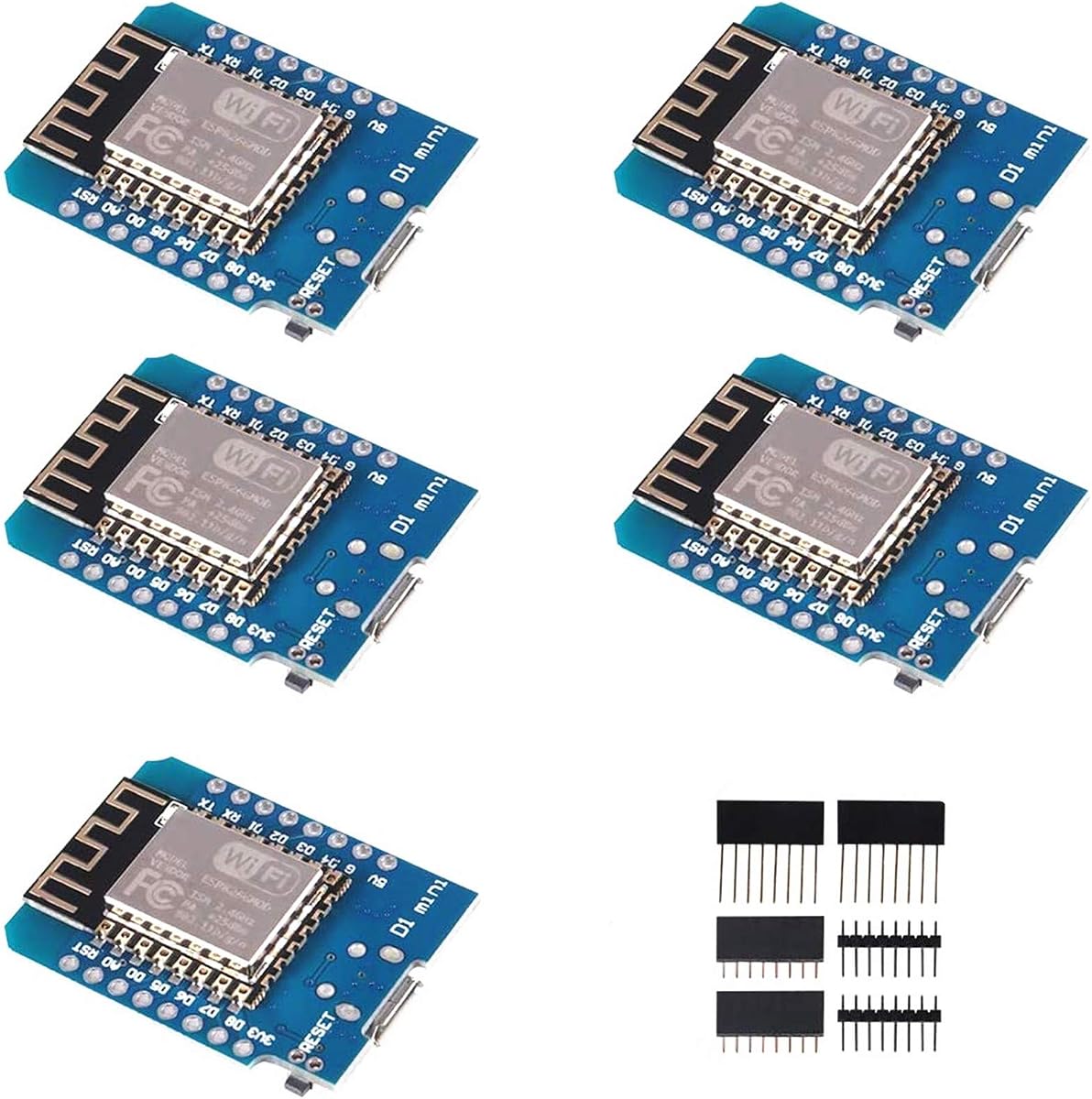
These D1 Mini boards feature onboard power supplies and Micro USB connections for easier power and programming. A 4.5 rating reflects user satisfaction with their compact size and functionality.
We may earn a commission when you buy through this link, at no additional cost to you.
They offer 11 digital input output pins all supporting interrupts and PWM for complex tasks. The built-in 5V switching power supply simplifies power delivery compared to bare modules.
Note that the storage is limited to 1MB which may restrict large codebases. Also the Micro USB ports on these boards are sometimes less durable than Type-C connectors.
Best for hobbyists wanting plug-and-play USB connectivity without external regulators. The GPIO count supports many sensors and displays making them very versatile for small projects.
The onboard power supply handles voltage regulation saving you the trouble of adding external components to your circuit.
With eleven digital pins you can connect multiple sensors and LEDs simultaneously for rich interactive feedback systems.
We may earn a commission when you buy through this link, at no additional cost to you.
This 10-pack delivers a massive quantity of ESP8266 modules ideal for large scale deployments. With a perfect 5.0 rating users praise the consistency and quality of the units included.
We may earn a commission when you buy through this link, at no additional cost to you.
Key benefits include robust on-board processing and ample storage for seamless data retention. The support for AP and STA modes offers flexible networking options for any application scenario.
As a bare module you will need breakout boards or adapters to use them comfortably. Also ensure you maintain stable 3.3V power to avoid damage during operation.
Choose this for bulk industrial or commercial sensor networks where cost efficiency is critical. The high rating suggests excellent quality control for mass production needs.
You can easily switch between station and access point modes to fit the specific needs of your network architecture.
The ESP8266 chip handles complex tasks and algorithms efficiently ensuring smooth operation for demanding wireless applications.
We may earn a commission when you buy through this link, at no additional cost to you.
Choosing the right WiFi module depends on your project requirements and budget. This section breaks down the critical factors you should consider before buying a module.
Different modules offer varying wireless signal strengths that affect how far your device can communicate. Higher quality antennas and newer chips like ESP32 provide better indoor range.
Look for models with strong signal ratings if your project is located far from the router.
Flash memory determines how much code and data you can store directly on the module. Larger memory allows for more complex programs without external storage.
Choose at least 4MB for projects needing extensive logging or multiple libraries.
Power draw varies significantly between modules especially when in sleep modes. Battery powered projects need efficient models like ESP32 with low power options.
Check current consumption specs to ensure compatibility with your power source.
Many modules operate strictly at 3.3V while Arduino boards use 5V logic. Connecting to 5V directly can destroy the module without proper level shifting.
Ensure you have a voltage regulator or converter ready for setup.
Some modules have built-in USB ports for programming while others are bare transceivers. Built-in USB simplifies uploads and testing.
Select a board with USB if you want plug-and-play convenience.
Modules may support different protocols like AT commands or native Arduino libraries. Native support often simplifies coding for beginners.
Verify compatibility with your chosen IDE before purchasing.
Buying multi-packs reduces the cost per unit significantly for large projects. This is useful if you are deploying multiple nodes.
Assess how many units you need upfront to save on shipping.
To get started with most modules you need to install the latest board support packages in your Arduino IDE software. Search for the specific ESP or Arduino board name to add the driver support.
Always ensure your power supply matches the module requirements to prevent electrical damage. Using a stable 3.3V regulator is essential for reliable operation without fluctuations.
Store unused modules in anti-static bags to protect sensitive pins from static discharge. Keep them dry and away from extreme temperatures for long-term reliability.
For beginners, boards with built-in USB like the Arduino UNO R4 WiFi or ESP32 Dev boards are recommended. They simplify uploading code and handling power without extra hardware.
Yes most ESP8266 modules like the ESP-01 and ESP-12 work with the Arduino IDE. You just need to install the board support and configure the settings correctly for the specific model.
Bare modules often require a dedicated 3.3V power source rather than drawing from the Arduino. Using a dedicated supply prevents brownouts during WiFi transmission peaks.
Range depends on the environment and antenna quality. Generally you can expect 20 to 100 meters line-of-sight indoors with standard modules.
STA mode connects the module to an existing router while AP mode makes the module act as a hotspot. Both are supported by most modules for flexibility.
Yes many ESP32 boards support Over-the-Air updates. This allows you to push new code via Wi-Fi without disconnecting cables.
The Arduino UNO R4 WiFi stands out as the top choice for advanced users needing dual core performance and modern connectivity. For budget projects the ESP8266 ESP-01S remains a solid reliable option.
Prioritize power consumption and voltage requirements when selecting a module to ensure stability. A good choice saves time during prototyping and ensures reliable long-term operation.
Remember to check current prices and stock availability as these factors change frequently. Compare listings to find the best deal for your specific project needs today.
