
Pyle Premium Direct Injection Audio Box
4.5Editor score
Passive DI unit hum eliminator
Input attenuator for signal control
Compatible with guitar and bass
A Bass Direct Box is essential for converting high impedance instrument signals to low impedance balanced signals. It ensures clean audio transmission to mixers and interfaces without noise or signal loss during live performances.
We compared ten top models based on build quality, sound fidelity, connectivity options, and user feedback. This list includes passive and active units suitable for beginners and professionals seeking reliable gear for studio and stage use.
Each pick highlights key strengths, pros, cons, and ideal use cases to help you choose wisely. Prices and availability change frequently, so verify current details before purchasing to ensure you get the best value available today.
4.5Editor score

4.7Editor score
4.8Editor score
As an Amazon Associate we earn from qualifying purchases.
This table provides a side-by-side comparison of all ten models, detailing their core specifications, connectivity, and unique features to help you make an informed decision.




The Pyle Premium Direct Injection Audio Box serves as an excellent entry point for musicians needing reliable signal conversion. With a solid 4.5 rating, it delivers clean audio without excessive noise or interference in live settings.
We may earn a commission when you buy through this link, at no additional cost to you.
Its passive design ensures simplicity, using a transformer to convert unbalanced signals to balanced XLR outputs. The built-in input attenuator allows you to manage signal levels effectively, preventing clipping during high-volume performances.
While it lacks the robust construction of high-end units, the Pyle box handles common home studio and small venue needs well. The detachable power cord adds flexibility, though the plastic components may not withstand heavy touring stress over time.
This model is best suited for beginners, hobbyists, or those on a tight budget who need a functional DI box quickly. If you prioritize affordability and basic hum elimination, this unit offers reliable value for casual use.
The hum eliminator feature effectively reduces buzz from ground loops, ensuring a cleaner signal path to your mixer or audio interface.
With 1/4 inch connectors and XLR outputs, this box connects seamlessly to guitars, basses, keyboards, and consumer audio systems effortlessly.
We may earn a commission when you buy through this link, at no additional cost to you.
The Pyle PDC21 builds on the original with a focus on durability, featuring an all-steel chassis designed to last through extended use. Its 4.5 rating reflects consistent performance in converting instrument signals cleanly for recording or live sound.
We may earn a commission when you buy through this link, at no additional cost to you.
Users appreciate the heavy-duty construction, which adds stability during gigs. The hum eliminator and ground lift adapter work well to reduce noise, making it a practical tool for connecting basses, guitars, and synthesizers without interference.
While the weight might be a downside for portable setups, the steel build ensures resilience against bumps. It supports up to 10 effects pedals, offering flexibility for signal chains, though it lacks advanced controls found in higher-tier units.
Ideal for local musicians seeking a sturdy, no-frills DI box, this model balances cost and build quality. If you need a reliable passive unit that withstands wear, the PDC21 is a solid choice for everyday applications.
The all-steel chassis provides robust protection against physical damage, ensuring long-term reliability even in demanding touring environments.
Connects effortlessly to keyboards, guitars, and basses, making it a versatile tool for various musical setups and studio recordings.
We may earn a commission when you buy through this link, at no additional cost to you.
The Radial Pro DI stands out as a professional-grade passive direct box, earning a 4.7 rating for its exceptional build and sound fidelity. Its custom transformer and I-beam construction ensure it handles stage abuse while delivering transparent audio conversion.
We may earn a commission when you buy through this link, at no additional cost to you.
Musicians value the clean signal path, which preserves tonal nuances without adding coloration. The rugged steel chassis makes it a staple on touring rigs, resisting drops and impacts that would damage lesser units in regular use.
While it is a single-channel unit, the focus on quality over quantity pays off for users needing reliability. The price reflects its premium status, but the longevity and performance justify the investment for serious performers and audio engineers.
Recommended for professionals and serious hobbyists, this DI box sets a standard for passive units. If you prioritize sound quality and durability in a compact form, the Radial Pro DI delivers outstanding value over time.
The custom transformer ensures low noise and high fidelity, preserving the natural tone of your bass or guitar through the signal chain.
The I-beam steel construction protects internal components, making this unit capable of surviving rigorous touring and heavy studio use.
We may earn a commission when you buy through this link, at no additional cost to you.
With an impressive 4.8 rating, the Whirlwind IMP 2 proves that budget-friendly DI boxes can still deliver professional quality. Its compact design and riveted TRHL transformer ensure clean signal conversion with minimal noise or interference in typical setups.
We may earn a commission when you buy through this link, at no additional cost to you.
Users appreciate its small footprint, allowing it to fit easily on crowded pedalboards. The transformer converts unbalanced instrument signals to balanced mic-level outputs efficiently, making it a versatile tool for both live and studio recording applications.
While it lacks extra features like pads or switches, the core performance is solid. The economical price does not compromise durability, as the metal casing resists wear, making it a practical choice for gigging musicians on a budget.
This box is ideal for those needing a reliable, simple DI solution without paying a premium. If you value quality sound and a small footprint, the IMP 2 offers exceptional value for musicians seeking proven performance.
The IMP 2's tiny footprint allows it to fit seamlessly on pedalboards, saving space while providing high-quality signal conversion.
TRHL transformers are riveted, not glued, ensuring better signal stability and durability compared to cheaper assembled units.
We may earn a commission when you buy through this link, at no additional cost to you.
The PYLE-PRO PDC22 distinguishes itself with dual-channel capability, allowing simultaneous connections for instruments or audio sources. Its 4.4 rating reflects solid performance in converting high-impedance signals to balanced outputs without significant noise issues.
We may earn a commission when you buy through this link, at no additional cost to you.
Built with an all-steel chassis, this unit offers better durability than standard plastic boxes. The input attenuator helps manage signal levels, preventing overload from active instruments while maintaining clean audio for mixing or recording sessions.
While some users report minor variations in performance, the dual-channel design adds significant utility for small bands. It is a practical solution for those needing more than one input without purchasing separate units or spending more on premium brands.
Ideal for budget-conscious bands or home studios needing flexible inputs, this DI box balances cost and functionality. If you need two inputs and reliable hum elimination, the PDC22 provides a convenient and affordable option.
Two channels allow you to connect two instruments simultaneously, reducing the need for multiple DI boxes in your setup.
The input attenuator provides control over signal levels, ensuring optimal output without distortion even with active instruments.
We may earn a commission when you buy through this link, at no additional cost to you.
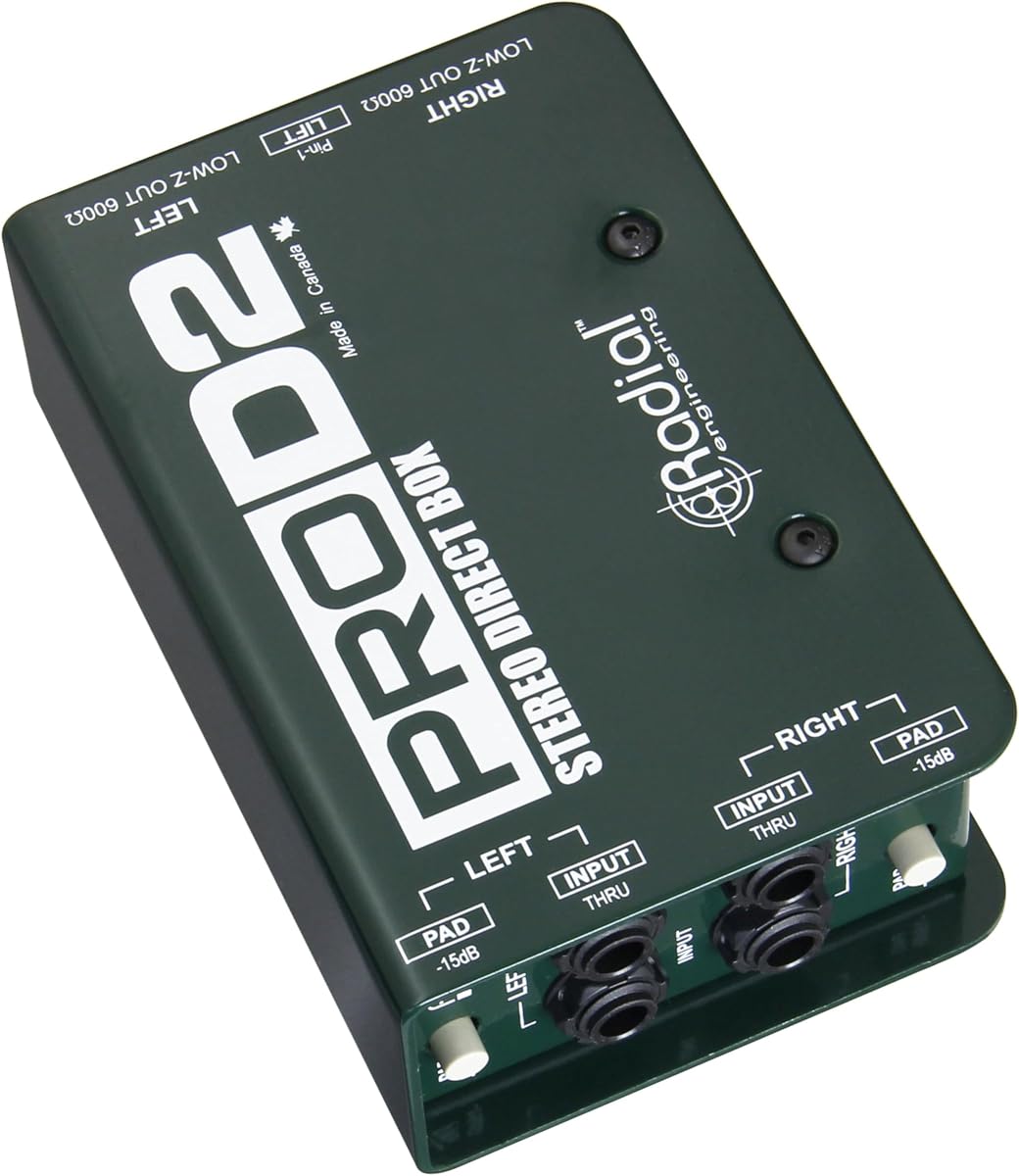
The Radial ProD2 offers professional-grade stereo isolation with dual channels, earning a 4.8 rating for its pristine signal integrity. Its passive design, combined with high-quality transformers, ensures that left and right signals remain separate without noise or crosstalk.
We may earn a commission when you buy through this link, at no additional cost to you.
Users benefit from the lift switch and 15dB pad, which provide precise control over ground loops and signal levels. This is essential for live performances where clean stereo imaging and noise management are critical for sound engineers.
While it is larger and pricier than mono units, the ProD2 is built to last, with Radial's signature steel construction. It excels with keyboards, synthesizers, and dual-output instruments, making it a top choice for bands requiring stereo inputs.
Recommended for touring musicians and professional setups, this DI box delivers unmatched reliability and sound. If you need a stereo solution that handles heavy use, the ProD2 is a premium investment worth considering.
Dual isolation transformers maintain full stereo separation, ensuring your mix remains intact without unwanted signal degradation or noise.
The ground lift switch and 15dB pad give you total control over interference and signal levels for any environment.
We may earn a commission when you buy through this link, at no additional cost to you.
The Bolanle DB2 provides a practical dual-channel solution for musicians needing flexible connectivity. With a 4.6 rating, it offers reliable hum elimination and clean signal conversion through balanced XLR outputs suitable for live and studio use.
We may earn a commission when you buy through this link, at no additional cost to you.
Its signal attenuation switch with three settings (-0dB, -20dB, -40dB) allows precise level control to prevent overload. The ground lift switch effectively reduces interference, ensuring a clear signal path even in noisy environments with heavy AC loads.
Built with a scratch-resistant, rust-proof design, the DB2 is suitable for frequent use and transport. While it may not match the build quality of premium brands, it provides excellent value for those needing stereo or dual inputs on a budget.
Ideal for small studios or live bands needing a versatile DI, this model combines affordability with useful features. If you need two channels and adjustable signal control, the DB2 is a solid choice for everyday applications.
Three signal attenuation settings help manage varying input levels, ensuring optimal output without distortion or clipping.
The ground lift switch eliminates loop interference, keeping your recordings and live performances clean and professional.
We may earn a commission when you buy through this link, at no additional cost to you.
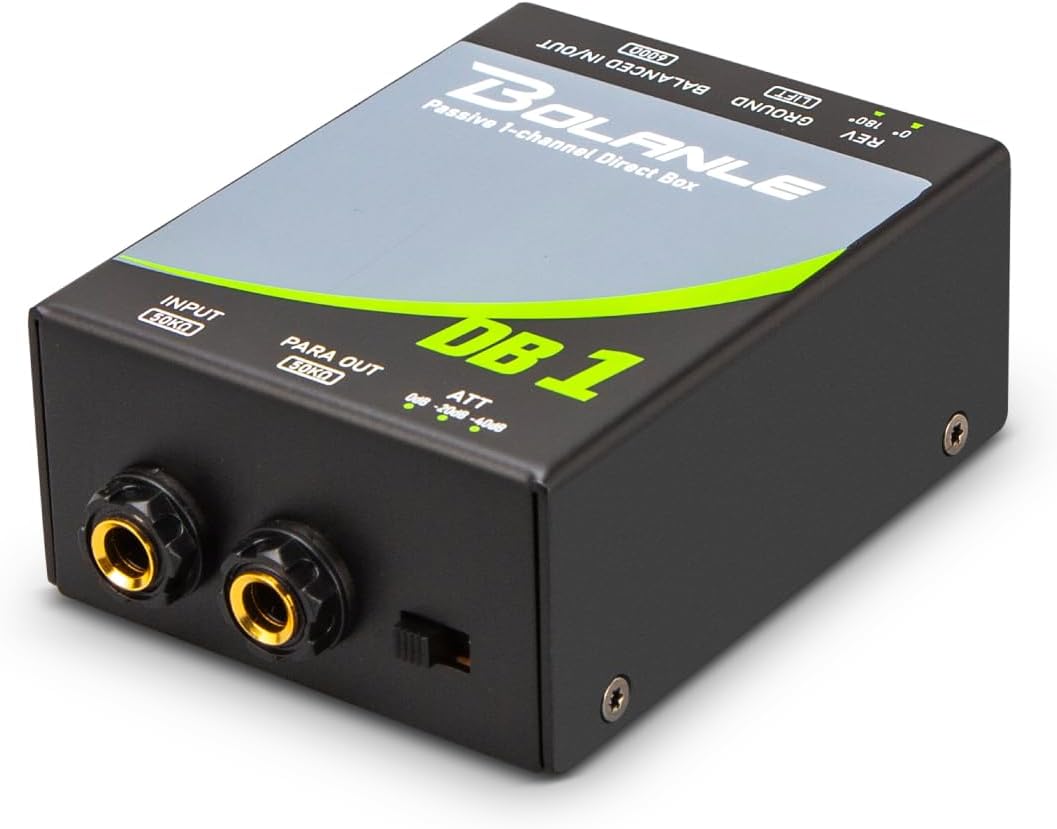
The Bolanle DB1 is a straightforward passive DI box that delivers clean mono signal conversion without needing power. Its 4.5 rating reflects consistent performance in eliminating hum and feedback, making it a reliable tool for guitarists and bassists.
We may earn a commission when you buy through this link, at no additional cost to you.
The built-in feedback eliminator and ground lift switch ensure noise-free transmission, while the signal attenuation switch prevents overload. The dual XLR and parallel outputs allow flexible connections to mixers and amps simultaneously without signal loss.
Its scratch-resistant and rust-proof chassis ensures durability in tour or studio environments. While it lacks advanced features, its simplicity and affordability make it an excellent option for musicians needing a dependable mono direct box.
Best for individuals or small setups, this box offers good value for entry-level and mid-level users. If you need a compact, passive DI unit with noise reduction features, the DB1 is a practical and budget-friendly choice.
No external power supply is required, allowing for effortless setup and operation anywhere without needing batteries or phantom power.
Balanced XLR and parallel outputs enable easy connection to mixers and amps, ensuring versatile integration into your signal chain.
We may earn a commission when you buy through this link, at no additional cost to you.
The Bolanle J22 stands out as an active stereo DI box with versatile power options, earning a 4.6 rating for its reliability. It supports 48V phantom power, a 9V battery, or USB power, ensuring you can run it on any stage.
We may earn a commission when you buy through this link, at no additional cost to you.
Users appreciate the dual-channel design with full stereo separation, ideal for keyboards and synths. The ground lift switch and metal housing provide noise-free performance and durability, making it a solid choice for touring and studio environments.
While batteries are not included, the flexibility to switch power sources prevents dead battery issues during critical performances. Its active circuitry ensures clean conversion of high-impedance signals without the limitations of passive transformers.
Best for musicians needing active stereo conversion, this model balances flexibility and affordability. If you value multiple power options and stereo support, the J22 delivers professional features at an accessible price point.
Three power options ensure uninterrupted operation, allowing you to adapt to any stage setup without worrying about power availability.
Active circuitry maintains full stereo separation, ensuring precise imaging for synths, keyboards, and dual-output instruments.
We may earn a commission when you buy through this link, at no additional cost to you.
The Radial Pro48 is a high-resolution active direct box designed for professional use, earning a 4.7 rating for its pristine audio quality. It runs on standard 48V phantom power, eliminating the need for batteries or external power supplies in most setups.
We may earn a commission when you buy through this link, at no additional cost to you.
Its 15dB pad helps manage high-level signals from passive instruments, ensuring clean conversion without clipping. The compact design makes it ideal for stage use, while Radial's build quality ensures it withstands rigorous touring and studio environments over time.
While it requires a phantom-powered mixer or interface, this feature ensures reliable operation without battery concerns. The active circuitry provides transparency and headroom that passive units may lack, making it a top choice for critical recording and live applications.
Recommended for professionals and studio engineers needing precision, this box offers exceptional performance. If you prioritize high-fidelity active conversion and reliability, the Pro48 is a worthy investment for demanding musical projects.
Active circuitry ensures transparent signal transfer, preserving tonal nuances and dynamic range in your recordings and live performances.
Built by a trusted brand, this unit offers consistent performance and durability, making it a reliable choice for demanding environments.
We may earn a commission when you buy through this link, at no additional cost to you.
Choosing the right Bass Direct Box depends on your specific needs, budget, and the type of gear you use. Understanding key factors ensures you pick a unit that delivers clean, reliable performance.
Passive DI boxes rely on transformers to convert signals without needing external power, making them simpler and more robust. Active units require phantom power or batteries but offer higher output and better handling of high-impedance sources like pickups.
Choose passive for reliability and simplicity or active for better signal integrity and control over impedance matching.
Single-channel units are sufficient for most solo instruments, but dual-channel or stereo options are essential for keyboards, synthesizers, or dual-output bass rigs. Stereo models preserve left and right separation for accurate imaging.
Assess how many inputs you need simultaneously to avoid buying extra units or limiting your setup.
Touring musicians require rugged chassis made of steel or aluminum to withstand drops and frequent transport. Studio users may prioritize smaller footprints or plastic housings to save space and reduce weight.
Invest in a durable model if you plan to move your gear often, as cheaper plastic units may degrade quickly.
Look for ground lift switches to eliminate hum and pads to reduce signal levels from active instruments. These features prevent clipping and ensure a clean path to your mixer or interface.
Having at least a ground lift and optional attenuation improves your ability to manage noise and dynamic range.
Ensure your box offers balanced XLR outputs and 1/4 inch inputs compatible with your instruments and mixer. Some models include parallel outputs for amp loops or reamping, adding flexibility to your signal chain.
Verify connectors match your existing gear to avoid needing extra cables or adapters.
Passive units need no power, while active ones require phantom power, 9V batteries, or USB. Consider your stage or studio setup to determine if a battery or phantom-powered system is feasible for your workflow.
Choose a power source that ensures uninterrupted performance during your longest sessions or gigs.
Prices vary widely from budget-friendly options to premium professional units. Reputable brands like Radial and Whirlwind often offer better warranties and consistent quality, while lesser-known brands may provide affordable alternatives.
Balance cost with long-term value, as a higher initial investment can save money on replacements over time.
A good DI box preserves the tonal characteristics of your instrument without adding coloration or noise. Active units often offer higher clarity and headroom, while passive units provide a natural sound with transformer warmth.
Listen to demos or reviews to confirm the unit matches the sonic quality you expect for your recordings.
Connect your instrument to the 1/4 inch input using a high-quality cable. For balanced setups, run an XLR cable from the DI output to your mixer or audio interface input.
Engage the ground lift switch if you hear a low-frequency hum or buzz in your signal. This eliminates ground loops and interference, ensuring a cleaner recording or live sound output.
Store your DI box in a padded case when not in use to protect it from impacts. Keep it in a dry environment to prevent rust and corrosion on connectors and the chassis.
A Bass Direct Box converts high-impedance instrument signals into low-impedance balanced signals. This allows your bass or guitar to connect directly to a mixer or audio interface without noise, signal loss, or interference during live or studio use.
Passive boxes are ideal for simple setups without power needs. Active boxes are better for long cable runs or high-impedance sources as they require phantom power or batteries. Your choice depends on your gear and environment.
Most DI boxes include a ground lift switch designed to break ground loops. Engaging this switch typically removes the low-frequency hum caused by multiple devices sharing a power source or ground connection.
Yes, DI boxes are commonly used with keyboards and synthesizers to convert their line-level signals to balanced mic-level outputs. Stereo models preserve left and right channels, which is critical for maintaining the intended mix.
No, only active DI boxes need phantom power. Passive units operate without external power using transformers. Ensure your mixer supports 48V phantom power if you choose an active model without battery options.
Yes, many DI boxes feature a parallel or direct output that allows you to send a signal to an amp for reamping. This helps capture a dry signal and blend it with amplified tones during production.
You will typically need a 1/4 inch cable for your instrument and an XLR cable to connect to your mixer or interface. Check if your unit requires additional connectors like TRS for stereo setups or parallel outputs.
High-quality DI boxes can last for decades with proper care, especially those with metal chassis and welded transformers. Avoid extreme conditions and store them in padded cases to prevent physical damage and extend their lifespan.
We reviewed the top 10 Bass Direct Box models ranging from budget-friendly Pyle options to professional Radial units. Each model offers distinct advantages depending on whether you prioritize affordability, durability, or advanced features.
Prioritize build quality and signal transparency for professional work, while casual users may find entry-level passive units sufficient. Consider power needs, channel counts, and connectivity to ensure the unit fits your existing setup seamlessly.
Prices and availability change often, so double-check current details before purchasing. Whether you choose the Pyle PDC21 for budget needs or the Radial ProD2 for premium performance, these selections offer reliable solutions for modern music production.