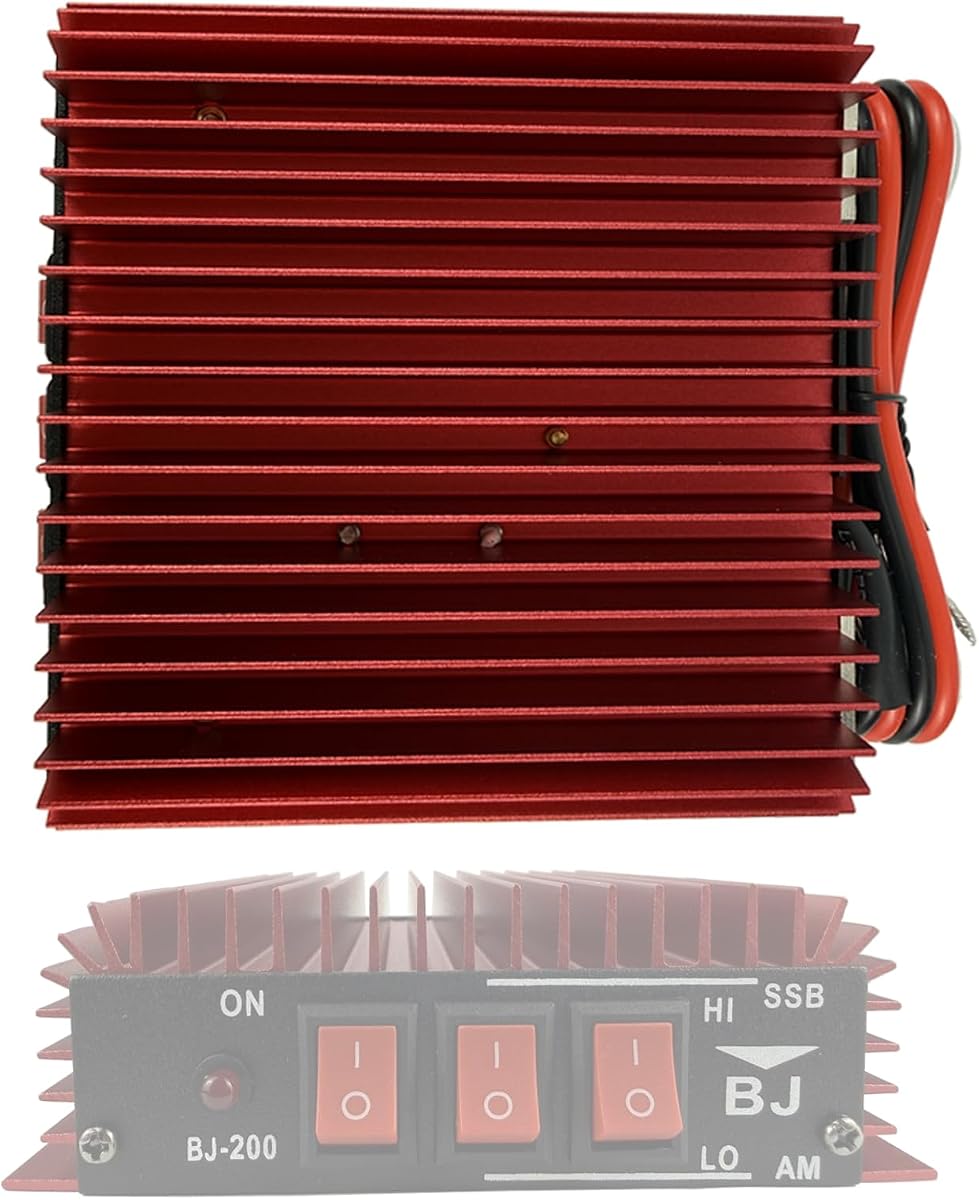
BJ-200 Linear Power AMP
5.0Editor score
Supports AM FM SSB modes
50W FM 100W AM 150W SSB output
Compact aluminum alloy heat sink design
This guide compares the top ten linear amplifiers for ham radio to help you choose the best model for your station setup and budget needs.
Linear amplifiers for ham radio are essential tools for operators looking to extend their communication range and signal clarity. Whether you operate a quiet QRP station or a full-power base setup, selecting the right amplifier ensures your transmissions meet legal limits while maximizing performance across HF bands.
We evaluated ten distinct models based on output power, band coverage, thermal management, and integration features. Our analysis focuses on real-world usability for amateur radio enthusiasts, considering factors like automatic band switching, protection circuits, and compatibility with popular transceivers used today.
Each pick below highlights key strengths and potential limitations to guide your purchase decision. We include detailed specifications and operational insights for every product. Please note that product availability and specific model features may change over time, so verify details before ordering.
5.0Editor score

4.2Editor score

3.9Editor score
This table provides a side-by-side comparison of all ten linear amplifiers evaluated in this guide. We highlight key specifications, output power ratings, and primary design features to help you quickly identify the model that best fits your operational requirements.


The Xiegu GPA100 stands out as a top contender for operators seeking a reliable and efficient linear amplifier for HF stations. With a rating of 4.2, this model delivers clean and stable RF output up to 100W on HF bands and 80W on 6 meters, making it suitable for SSB, AM, FM, CW, and digital modes.
We may earn a commission when you buy through this link, at no additional cost to you.
Its standout quality lies in its intelligent design features, particularly the flexible band switching options. Operators can choose manual buttons with indicator lights or enable auto mode for seamless tracking. The built-in Bluetooth allows wireless connection to compatible transceivers like the IC-705, reducing cable clutter while maintaining synchronization.
While the amplifier offers robust protection against high SWR, overcurrent, and overheating, its performance is best maximized when paired with supported radios that provide ALC feedback. Users should ensure their setup allows for this integration to fully benefit from the automatic band-synchronization capabilities.
Ham operators looking to upgrade their QRP setups to a 100W station will find this unit an excellent investment. The combination of signal purity, safety features, and wireless control makes it a highly recommended choice for those who value reliability and ease of use in their transmission chain.
The auto band switching feature ensures the amplifier follows your frequency changes automatically, reducing interruptions during contests or DXing sessions.
Bluetooth integration allows for a cleaner setup, especially useful in portable operations where cable management is critical for efficiency.
We may earn a commission when you buy through this link, at no additional cost to you.
The BJ-300 Plus is a versatile broadband linear amplifier designed to support multiple modulation modes including AM, FM, SSB, and CW. With output capabilities of up to 150W on SSB, it aims to extend communication range for reliable long-distance operation in both CB and ham radio environments.
We may earn a commission when you buy through this link, at no additional cost to you.
Key strengths include its reliable thermal management system, featuring a high-efficiency cooling fan and large aluminum heat sink to prevent overheating during extended use. The unit is equipped with electronic polarity reversal protection and dual fuses to safeguard against electrical surges and incorrect connections.
However, users should note that this model requires specific input power levels, typically 3-5W for AM/FM or 2-10W for SSB. Ensuring your transceiver matches these requirements is crucial for optimal performance. The compact design and standard PL-259 connectors make installation straightforward for most users.
This amplifier is a practical choice for operators seeking a straightforward power boost without complex electronics. While ratings vary, the protective features and high output make it a viable option for those needing to amplify signals efficiently across various HF bands.
The 150W SSB output allows for stronger signals, which can be particularly useful in areas with high noise floors or during weak signal conditions.
Reverse polarity protection and fuses provide essential safeguards, reducing the risk of damage during installation or accidental power surges.
We may earn a commission when you buy through this link, at no additional cost to you.
This version of the BJ-300 Plus shares similar high-power capabilities with the previous model, offering up to 150W on SSB and 120W on AM. It is designed to extend communication range and supports AM, FM, SSB, and CW modulation modes for versatile use across HF bands.
We may earn a commission when you buy through this link, at no additional cost to you.
A key feature is the reliable thermal management system, which includes a high-efficiency cooling fan and large aluminum heat sink. This ensures stable operation even during long sessions, preventing overheating that could damage internal components or degrade signal quality over time.
Operators should be mindful of the input power requirements, as the unit expects 3-5W for AM/FM or 2-10W for SSB. Proper matching with your transceiver is essential. The simple controls and standard PL-259 connectors make it accessible for both new and experienced users looking to amplify their signals.
While this model provides a straightforward solution for amplification, verifying compatibility and power stability is recommended. It serves well for operators needing a basic boost to their signal strength without needing advanced automatic tuning features.
The cooling fan and heat sink work together to maintain consistent performance, crucial for maintaining signal purity during prolonged transmission periods.
We may earn a commission when you buy through this link, at no additional cost to you.
The BJ-300 is a compact linear amplifier designed for HF transceiver applications, capable of delivering up to 150W on SSB. It supports multiple modulation modes including AM, FM, SSB, and CW, making it ideal for versatile communication across the HF frequency range.
We may earn a commission when you buy through this link, at no additional cost to you.
Its features include dual power control with HI/LO switches to adjust output strength based on needs, along with overvoltage protection to safeguard against incorrect power connections. The durable aluminum alloy heat sink ensures efficient heat dissipation, supporting stable operation during extended use.
Users should note that the unit requires specific input power levels, typically 3-5W for AM/FM or 2-10W for SSB. Ensuring your transceiver matches these specs is vital for optimal amplification. Standard antenna and transceiver ports simplify installation for most setups.
This model is suitable for operators seeking a cost-effective way to boost signal strength without complex integration. While data is limited, its protective features and power output make it a functional option for HF stations needing a reliable linear amplifier.
The ability to switch between HI and LO power provides flexibility, allowing operators to conserve energy or adjust to specific propagation conditions.
We may earn a commission when you buy through this link, at no additional cost to you.
The BJ-200 is a highly rated linear power amplifier offering output of up to 150W on SSB across the 3-30MHz range. It supports AM, FM, and SSB modes, making it a versatile choice for CB radio and amateur radio operators needing reliable signal boost.
We may earn a commission when you buy through this link, at no additional cost to you.
Operational safety is enhanced by its built-in polarity reversal protection, which prevents damage from incorrect power connections. The efficient heat dissipation design using a red aluminum alloy heat sink ensures optimal thermal management during continuous use, extending the amplifier's lifespan significantly.
Its compact and rugged build factor makes it suitable for vehicle or base station installations. Standard radio connectors simplify the setup process. While it lacks advanced features like automatic tuning, its reliability and clear controls make it a solid pick for users prioritizing straightforward performance.
For operators seeking a budget-friendly solution without compromising safety, this amplifier is an excellent candidate. Its high ratings suggest strong customer satisfaction, particularly regarding its ability to maintain stable performance across various transmission modes.
The ON/OFF switch and HI/LO power adjustment provide intuitive operation, reducing the learning curve for new users entering the hobby.
We may earn a commission when you buy through this link, at no additional cost to you.
The Xiegu XPA125B combines a power amplifier and automatic antenna tuner into a single unit, making it perfect for QRP radios needing 100W output. Its maximum power output reaches 125 watts, ensuring robust communication capabilities for operators across HF bands and the 6-meter band.
We may earn a commission when you buy through this link, at no additional cost to you.
Its standout feature is the integrated automatic antenna tuner, which handles loads from 14 to 500 ohms independently or alongside the amplifier. The large 2.7-inch backlit LCD display shows critical data like input/output power, SWR, temperature, and warning messages for simplified operation.
Protection circuits ensure safety by entering bypass mode during high SWR or overheating events, displaying alarm messages to alert the user. While its compact size is impressive, it relies on external power supplies for operation. Users should verify their power setup meets the required voltage specifications.
This amplifier is ideal for enthusiasts seeking a streamlined setup without separate tuner units. The combination of power, tuning, and monitoring tools in one device offers high convenience and operational efficiency for modern ham radio stations.
The automatic tuner reduces the need for external components, saving space and simplifying the signal chain for portable and fixed stations.
We may earn a commission when you buy through this link, at no additional cost to you.
This board is a 30W linear amplifier module designed to deliver ample signal boost for ham radio transceivers across the shortwave spectrum. It focuses on CW and SSB modes, offering high-frequency operation from 3MHz to 30MHz for reliable signal amplification during QSOs.
We may earn a commission when you buy through this link, at no additional cost to you.
Key features include advanced broadband circuitry that delivers consistent gain across the range without manual tuning. The integrated heat sink and low-loss PCB material ensure thermal stability during extended transmit cycles. It also protects against overcurrent and voltage fluctuations for reliable operation.
Installation is straightforward with clearly marked input/output ports and power connections. Compatible with a wide range of QRP transceivers and kits, it is perfect for home or field day setups. While it lacks a finished enclosure, its design facilitates easy integration into custom stations.
For operators looking to build or modify their own signal chain, this module offers a powerful and efficient solution. Its compact nature makes it versatile for various amateur radio applications requiring precise linear amplification.
The consistent gain across the full shortwave range simplifies operations, removing the need to manually tune the amplifier for different bands.
We may earn a commission when you buy through this link, at no additional cost to you.
This BJ-200 variant is designed specifically for CB radio applications, featuring a wide 12-14V DC input range. It ensures stable operation even during engine starts, making it a reliable choice for mobile stations requiring consistent power handling across various supply conditions.
We may earn a commission when you buy through this link, at no additional cost to you.
Installation involves a simple three-wire connection using RF input, RF output, and DC power ports. The standard SO-239 connector supports most CB radios and antenna systems, facilitating a quick setup without specialized tools. This design prioritizes ease of use for vehicle-based operators.
While the output specs are not explicitly detailed in the summary, its compatibility with standard CB power supplies makes it a practical solution for users in that ecosystem. It focuses on providing a straightforward amplification path for communication needs on road or base setups.
Operators looking for a basic, voltage-tolerant amplifier for their CB radio will find this unit functional. Its simplicity and robust power input design make it a viable option for those needing to maintain clear signals in mobile environments.
The wide DC input range ensures the unit remains functional even when vehicle power fluctuates, protecting the amplifier from instability.
We may earn a commission when you buy through this link, at no additional cost to you.
This low noise amplifier (LNA) operates across an exceptionally wide range from 0.1MHz to 2000MHz, covering shortwave, FM broadcast, and even 2G/3G/4G signals. With a typical gain of 32dB, it significantly improves weak signal reception for ham radio and SDR applications.
We may earn a commission when you buy through this link, at no additional cost to you.
Its low noise figure ensures that the signal quality remains high while boosting the incoming signal. The unit supports 9V to 12V power supplies with only 27mA current consumption, making it suitable for portable field use or fixed installation with a 12V adapter.
Designed as a preamp for receiving front-end applications, it has a maximum output of 13dBm, which is not intended for transmitting. However, its versatility makes it ideal for CB radio, shortwave listening, and improving reception quality in noisy environments.
For operators dealing with weak signals, this LNA provides a reliable method to enhance clarity without adding excessive noise. It is an excellent addition to any station focused on improving receiving capabilities across a broad spectrum of frequencies.
By boosting weak signals before they reach the receiver, this amplifier helps maintain audio clarity even when dealing with distant stations.
We may earn a commission when you buy through this link, at no additional cost to you.
This amplifier is specifically designed to enhance Xiegu transceivers, delivering a maximum output power of 100W in the HF frequency range. It features advanced automatic tuning functionality, allowing users to focus on communication without manual adjustments during operation.
We may earn a commission when you buy through this link, at no additional cost to you.
The consistent output ensures that maximum power is automatically maintained across bands. Constructed from high-quality materials, it guarantees durability and reliability for long-term use. The unit includes a professional after-sales service network to ensure a perfect user experience for all owners.
Compatibility is optimized for G90, G106, X5105, X6100, X6200, and future Xiegu models. While its features are tailored to this ecosystem, the operational efficiency and professional support make it a standout choice for Xiegu users.
For operators invested in the Xiegu brand, this amplifier offers a seamless upgrade to 100W performance. Its automatic tuning and robust build quality make it a highly efficient addition to a modern radio station setup.
By being designed specifically for Xiegu radios, this unit reduces compatibility issues and ensures smooth interaction between the transmitter and amplifier.
We may earn a commission when you buy through this link, at no additional cost to you.
Selecting the right linear amplifier involves balancing power output, frequency range, and safety features. This guide outlines the essential factors to consider to ensure compatibility with your station and legal compliance.
Determine how much power you need based on your operational goals. Most ham operators aim for 100W to maximize signal reach without exceeding legal limits. Ensure the amplifier can deliver clean power across all bands you use regularly.
Always choose a model that matches your desired output range to avoid wasting money on capabilities you will not utilize.
Verify that the amplifier supports the HF bands you intend to operate on. Some units cover a wide range while others may have limitations. Automatic band switching can be a valuable feature for multi-band stations to reduce manual intervention.
Look for units that explicitly state HF coverage and check if they support the specific bands you operate most frequently.
Your transceiver must provide the correct drive level for the amplifier to function correctly. Most units require 3-5W for AM/FM or 2-10W for SSB. Matching this is essential to avoid underdrive or overdrive issues that could damage equipment.
Check your radio's output specifications to ensure it aligns with the amplifier's input requirements.
Protection circuits are critical for safe operation. Look for features like SWR protection, thermal shutdown, and polarity reversal protection. These features help prevent damage from improper connections or extreme conditions.
Always prioritize units with robust protection systems to safeguard your investment and ensure long-term reliability.
Effective cooling is necessary to maintain signal purity during extended use. Amplifiers with built-in fans and aluminum heat sinks generally perform better under load. Proper thermal management extends the lifespan of internal components significantly.
Ensure the unit has adequate ventilation and cooling features for your typical operating duration.
Consider how the amplifier connects to your station. Units with Bluetooth or auto-tuning features offer greater convenience. Standard connectors like PL-259 or SO-239 ensure easy integration with existing antenna systems.
Evaluate the interface options to see if they simplify your workflow in the shack.
Durable construction ensures the unit survives the rigors of daily use. Look for aluminum casings and robust internal components. Portable or field-day setups benefit from rugged designs that can withstand movement.
Invest in a model with a reputation for durability to avoid frequent replacements.
Integrated antenna tuners simplify the station setup by reducing the number of components. Units like the Xiegu XPA125B combine tuning and amplification in one box. This integration saves space and reduces cabling complexity.
Decide if an all-in-one solution fits your station layout and operational needs.
Connect the amplifier between your transceiver and antenna using high-quality coaxial cables. Ensure all connectors are securely fastened to prevent RF leakage. Proper grounding is essential to avoid electrical hazards and maintain signal integrity.
Monitor the amplifier's status indicators during transmission to detect any warnings such as high SWR or overheating. Allow the unit to cool down between heavy sessions to extend its lifespan. Regularly check fans for debris to ensure optimal airflow.
Store the amplifier in a dry, dust-free environment when not in use. Avoid exposure to extreme temperatures that could degrade internal components. Periodic inspection of power connections and fuses will help ensure safe operation over time.
The primary benefit is increased communication range and signal clarity. Amplifiers boost your transmitter's power to the maximum legal limit of 100W, allowing you to reach distant stations more easily. They also improve your ability to work weak signals in noisy conditions.
It depends on the model. Some amplifiers like the Xiegu XPA125B include a built-in automatic tuner, simplifying your setup. Others require a separate tuner to match your antenna impedance to the amplifier. Check the product details before purchasing to confirm this feature.
Safety is ensured by checking that the unit has protection circuits for SWR and heat. Always use the recommended power supply and ensure the amplifier is properly grounded. Regular maintenance of cooling fans also prevents overheating during operation.
Not all transceivers are compatible. Amplifiers typically require specific drive levels. You must check that your radio can provide the required input power. Some units offer Bluetooth synchronization to ensure seamless band tracking with compatible radios.
Transmit amplifiers boost outgoing signals, while receive amplifiers boost incoming signals. The LNA listed is for receiving and does not transmit. Always verify the device is intended for your specific application to avoid damage.
Most modern units operate immediately after turning on. However, allowing them to reach stable temperature during operation is good practice. Some high-power units may benefit from a brief warm-up period for optimal performance.
This guide highlights ten distinct models ranging from budget options to premium units with integrated tuners. The Xiegu GPA100 offers the best overall balance of features, while the BJ-200 provides a solid budget-friendly choice. For those needing automatic tuning, the XPA125B is highly recommended.
When choosing, prioritize compatibility with your existing transceiver and the output power you need. Look for units with strong protection features and good thermal management to ensure long-term reliability. Always consider how well the model fits your operating style and station setup.
Please note that prices and availability can fluctuate regularly. We recommend checking current listings to verify that the specifications match your needs before placing an order. Investing in the right amplifier will significantly enhance your communication capabilities.